Categories
Culture, Society & Family Economics & Statistics Researcher news SMU In The News Student researchers Technology

CoinDesk: Research — Over $11 Million Lost in Bitcoin Scams Since 2011

The researchers painstakingly read forum threads post by post, even translating messages written in languages other than English.

Bitcoin, SMU, scammers, $11 million, Moore, Vasek

With the cryptocurrency Bitcoin increasingly popular for digital transactions, the digital currency news site CoinDesk covered the research of SMU Bitcoin experts Marie Vasek, lead researcher on the study, and Tyler W. Moore, both in SMU’s Computer Science and Engineering Department in the Lyle School of Engineering.

The study by Vasek and Moore, “There’s no free lunch, even using bitcoin: Tracking the popularity and profits of virtual currency scams,” found that fraudulent schemes have scammed at least $11 million in Bitcoin deposits from unsuspecting cyber customers over the past four years.

Bitcoin is the digital world’s most popular virtual currency, with millions in circulation.

The study is the first empirical study of its kind. Vasek and Moore found that hucksters used four different types of schemes through authentic-looking web-based investment and banking outlets to lure customers and heist deposits.

Vasek explained to CoinDesk journalist Joon Ian Wong how the researchers extracted Bitcoin addresses linked to the frauds, enabling them to look at transactions from victims to fraudsters recorded on the transaction addresses.

The CoinDesk article, Research: Over $11 Million Lost in Bitcoin Scams Since 2011, published Jan. 29, 2015.

Read the full story.

EXCERPT:

By Joon Ian Wong
CoinDesk

Scams promising bitcoin riches have netted swindlers at least $11m in the last four years, researchers have found.

Some 13,000 victims handed over their money unwittingly in 42 different scams over that time period, their data suggests.

However, the total amount of funds cheated from victims over this period is almost certainly higher than the estimated $11m the research identified.

A co-author of the research, Marie Vasek, said:

“There are a lot of scams that we couldn’t measure at all. There were scams we couldn’t find or verify … We think presenting our findings as they are, a lower bound, makes a lot of room for us and others to further quantify scams in this space.”

Vasek, who researches computer security at Southern Methodist University, co-wrote the paper with Tyler Moore, an assistant professor in computer science at the same institution.

Painstaking search
The paper, titled There’s No Free Lunch, Even Using Bitcoin: Tracking the Popularity and Profits of Virtual Currency Scams, has been presented at the Financial Cryptography and Data Security conference taking place in Puerto Rico this week.

Vasek and Moore combed online repositories of scam accusations, including a mega-thread of scams, hacks and heists on the Bitcointalk forum that has been maintained since 2012, as well as the subreddit r/bitcoin, BadBitcoin.org and CryptoHYIPs.com.

This process required the researchers to painstakingly go through forum threads post by post, even translating messages that were written in languages other then English, as well as visiting the websites that scammers created to publicise themselves.

“We went through every single post to determine if the scheme was a scam, any associated bitcoin addresses with the scheme, and any associated scams,” Vasek said.

Using this method they found 349 scams, which were then whittled down to 192 deceptions after excluding phishing, malware and pay-for-click websites, which fall outside the scope of the study.

Read the full story.

Follow SMUResearch.com on twitter at @smuresearch.

SMU is a nationally ranked private university in Dallas founded 100 years ago. Today, SMU enrolls nearly 11,000 students who benefit from the academic opportunities and international reach of seven degree-granting schools. For more information see www.smu.edu.

SMU has an uplink facility located on campus for live TV, radio, or online interviews. To speak with an SMU expert or book an SMU guest in the studio, call SMU News & Communications at 214-768-7650.

Categories
Culture, Society & Family Learning & Education Mind & Brain Researcher news SMU In The News Technology

New World Notes: Virtual Reality-Based Assertiveness Training Reportedly Leads to Less Sexual Victimization, Pilot Program Finds

Can virtual reality and 3D gaming help people stand up for themselves in real life?

Virtual reality, SMU, assertiveness training, sexual assault

Journalist Wagner James Au, who delves into the details of all things Metaverse on his New World Notes blog, covered the research of SMU clinical psychologist Lorelei Simpson Rowe and her co-authors Ernest N. Jouriles and Renee McDonald.

Au’s coverage includes details of how SMU researchers developed the training simulation by modifying the popular first-person video game Half-Life 2, combined with a virtual reality headset.

Simpson Rowe, an associate professor and graduate program co-director in the SMU Department of Psychology, is lead author on the pilot study from SMU.

The virtual-reality simulation component of “My Voice, My Choice” utilizes a software program developed by Jouriles and McDonald in conjunction with SMU’s award-winning Guildhall video gaming program. Jouriles and McDonald are clinical psychologists in the SMU Psychology Department. Jouriles is professor and chair. McDonald is a professor and associate dean of research and academic affairs for Dedman College of Humanities and Sciences.

Results of their study found teen girls were less likely to report being sexually victimized after learning to assertively resist unwanted sexual overtures and practicing resistance in a realistic virtual environment.

The effects persisted over a three-month period following the training.

The New World Notes blog article, “Virtual Reality-Based Assertiveness Training Reportedly Leads to Less Sexual Victimization, Pilot Program Finds,” was published Jan. 28.

Read the full blog post.

EXCERPT:

By Wagner James Au
New World Notes

Can virtual reality and 3D gaming help people stand up for themselves in real life? In a pilot study developed by Southern Methodist University, a group of young women practiced assertiveness against male sexual aggression using a modified version of Half-Life 2 and a VR headset. After the training (dubbed “My Voice, My Choice”), as this summary indicates, the early results were extremely positive: “22 percent in the control group reported sexual victimization during the three-month follow-up period, compared to only 10 percent in the ‘My Voice, My Choice’ group.” (Emphasis mine, because it bears emphasis.) While this is just initial data working from a small sample, the growth of virtual reality makes this study one worth repeating in other pilot programs, so I reached out to the lead researchers, Dr. Lorelei Simpson Rowe and Anthony Cuevas, for more details on their training program:

What were some of the most interesting personal reactions to this simulation?

Dr. Lorelei Simpson Rowe: “Many participants were surprised at how difficult it was to be assertive. They thought of themselves as being able to be assertive, but found it more challenging in the simulations than they expected. At the same time, many of the participants also seemed to feel more confident after they successfully used the skills and got positive feedback from others.

“Most students chose to participate in the study because they were given gift cards to thank them for their time – they weren’t initially interested in the program – but afterward, they told us how important it was and that they felt all students should go through MVMC.”

What advice would you give other researchers and developers working on similar VR experiences?

Dr. Lorelei Simpson Rowe: “I think important next steps will include developing fully computerized protocols (i.e., those that don’t require an actor). Additionally, the simulations need to be realistic and consistent with experiences that participants might actually have.”

Read the full blog post.

Follow SMUResearch.com on twitter at @smuresearch.

SMU is a nationally ranked private university in Dallas founded 100 years ago. Today, SMU enrolls nearly 11,000 students who benefit from the academic opportunities and international reach of seven degree-granting schools. For more information see www.smu.edu.

SMU has an uplink facility located on campus for live TV, radio, or online interviews. To speak with an SMU expert or book an SMU guest in the studio, call SMU News & Communications at 214-768-7650.

Categories
Health & Medicine Mind & Brain Researcher news Technology

$2.5 million awarded to Retina Foundation and SMU Lyle to study macular degeneration

Research partners in collaborative venture will help rapidly prototype new diagnostic and clinical treatment approaches

An example of the impaired vision of a person suffering with macular degeneration.
Vision impaired by age-related macular degeneration, a progressive, degenerative disease of the retina and the most common cause of vision loss for people over 50.

The Retina Foundation of the Southwest and SMU’s Bobby B. Lyle School of Engineering will collaborate to create the Clinical Center of Innovation for Age-Related Macular Degeneration.

Supported by a $2.5 million grant award from the W. W. Caruth, Jr. Foundation at Communities Foundation of Texas (CFT), the center will be housed at the Retina Foundation in Dallas.

The new collaborative venture will help to rapidly prototype new diagnostic and clinical treatment approaches, focusing on the specific needs of patients who are losing their vision to age-related macular degeneration.

Physician Karl Csaky, Chief Medical Director and T. Boone Pickens Senior Scientist at the Retina Foundation of the Southwest, will lead the joint venture, along with Marc Christensen, Dean of SMU’s Lyle School of Engineering.

Age-related macular degeneration is a progressive, degenerative disease of the retina and is the most common cause of vision loss for individuals 50 years and older. Currently, there are 18 million Americans who have some form of age-related macular degeneration.

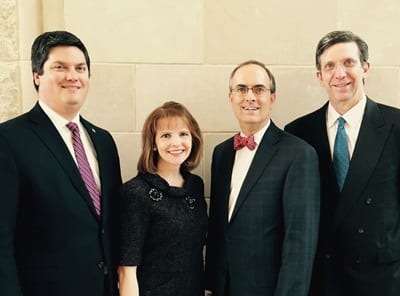
Pictured, left to right, Marc Christensen, Dean, Lyle School, SMU; Monica Egert Smith, Community Philanthropy Director, W.W. Caruth, Jr. Foundation; Brent Christopher, President and CEO, Communities Foundation; and Karl Csaky, Chief Medical Officer, Retina Foundation.

It is projected that the population over the age of 60 will double by the year 2030, which will dramatically increase the number of individuals affected by this disease. At present there are few effective treatments for the majority of patients who suffer from age-related macular degeneration.

“I am extremely thankful to the Caruth Foundation for providing their generous support for a unique approach to help patients with age-related macular degeneration,” said Dr. Csaky. “This one of a kind initiative will focus on leveraging the strengths of two preeminent Dallas institutions.”

This $2.5 million award from the W. W. Caruth, Jr. Foundation at CFT recognizes the great need to develop an innovative approach to medical research for age-related macular degeneration, adapting new technologies and treatments that directly correlate to the patients’ disease state. “This type of unique partnership between a top engineering school and a clinical research organization has the potential to be replicated in other areas of medicine as well,” said Brent Christopher, President and CEO of Communities Foundation of Texas. “This model of pairing disparate disciplines to tackle challenging medical issues is the transformational approach Will Caruth would have championed.”

Since 1982, the Retina Foundation of the Southwest has been on the leading edge of basic research to better understand age-related macular degeneration and how it works to destroy central vision, which is necessary for reading, writing and driving. The Foundation also works closely with patients in a clinical setting to better understand the vision loss they are experiencing over time.

SMU’s Lyle School of Engineering is dedicated to the role of innovation in finding solutions to real-world problems and has a dedicated space for those pursuits – the Deason Innovation Gymnasium. The Lyle School will help to accelerate the clinical application of technologies.

“We are grateful for this opportunity to collaborate with Retina Foundation doctors to help develop and prototype treatments tailored to patient needs,” said Christensen. “For example, we’ll be in a position to tackle problems such as the delivery of medication to the retina through polymer chemistry and mechanical engineering. Engineering and medicine can partner in astounding ways, and we are excited to see how our framework for fostering innovation accelerates solutions to medical challenges.”

The opportunity presented by the W. W. Caruth, Jr. Foundation at CFT to collaborate with the Retina Foundation of the Southwest supports SMU and the Lyle School in the University’s commitment to increased research being advanced by the Second Century Campaign. — Kim Cobb

Click here and scroll down for information about the collaborative entities.

Follow SMUResearch.com on twitter at @smuresearch.

SMU is a nationally ranked private university in Dallas founded 100 years ago. Today, SMU enrolls nearly 11,000 students who benefit from the academic opportunities and international reach of seven degree-granting schools. For more information see www.smu.edu.

SMU has an uplink facility located on campus for live TV, radio, or online interviews. To speak with an SMU expert or book an SMU guest in the studio, call SMU News & Communications at 214-768-7650.

Categories
Culture, Society & Family Economics & Statistics

Data-driven assessment ranks U.S. Metropolitan Areas by arts and cultural assets

NCAR, SMU’s National Center for Arts Research, creates index to measure arts vibrancy of U.S. Metropolitan Areas

NCAR, SMU’s National Center for Arts Research, today released its first annual Arts Vibrancy Index.

The index ranks more than 900 communities across the country. Vibrancy is measured as the level of supply, demand and government support for arts and culture on a per capita basis. The report highlights the top 20 large markets and top 20 medium and small markets. NCAR provides rank scores on all measures for every U.S. county on the interactive heat map.

“The numbers are only the start of the story, not the end. Each city in our report is unique in what makes it a vibrant community for the arts,” said Zannie Giraud Voss, director of NCAR and chair and professor of arts management and arts entrepreneurship in SMU’s Meadows School of the Arts and Cox School of Business. “Our intention in developing this report is to stimulate conversation about what makes a city vibrant in the arts and how arts vibrancy varies across cities.”

The overall index is composed of three dimensions.

Supply is assessed by the total number of arts providers in the community, including the number of independent artists, arts, culture and entertainment employees, and arts organizations.

Demand is gauged by the total nonprofit arts dollars in the community, including program revenue, contributed revenue, total expenses and total compensation.

Level of government support is based on state arts dollars and grants and federal arts dollars and grants.

girls, virtual reality, say no, sexual violence, assertiveness training, Rowe, Jouriles, McDonald, SMU
SMU, Meltzer, women, body image
supervolcano, fossil, Italy, James Quick, Sesia Valley
Brian Stump, SMU, earthquakes
Meltzer, contraception, couples, happiness
Blue light, Zoltowski, SMU
Morrison Formation, Jurassic, climate, ancient soil, Myers, paleosols

Geographically, the rankings utilize Metropolitan Statistical Areas (MSAs), which are delineated geographic areas consisting of one or more counties that have high social and economic integration with an urban core as defined by the Office of Management and Budget. By focusing on MSAs, the index captures the network of suburbs that rise up around a city or town rather than considering them separately.

Among cities with populations of 1 million or more, the five most vibrant arts communities are as follows:

Washington-Arlington-Alexandria, D.C.-Virginia-Maryland-West Virginia
Nashville-Davidson-Murfreesboro-Franklin, Tennessee
New York-Jersey City-White Plains, New York-New Jersey
Boston, Massachusetts
San Francisco-Redwood City-South San Francisco, California

For medium and small cities, with population under 1 million, the top five cities are all in the West:

Glenwood Springs, Colorado
Santa Fe, New Mexico
Jackson, Wyoming-Idaho
Breckenridge, Colorado
Edwards, Colorado

The full top-20 lists are available on the NCAR Arts Vibrancy Index, including scores on each of the three dimensions of supply, demand and government support.

Beyond the specific rankings, select key findings in the Arts Vibrancy Index include:

No region has cornered the market on arts vibrancy. Cities large and small from every region appear in the top 40 cities, although there is high representation from Western communities in the set of Medium-Small cities.

Arts vibrancy takes many shapes and forms. Some cities have impressive financial resources invested in nonprofit arts and cultural institutions, others are filled with many smaller organizations and venues, some are tourist destinations and still others are artist colonies. Some cities are strong in numerous arts sectors while others are capitals of a particular art form.

There are interesting differences across very large Metropolitan Statistical Areas (MSAs). Those that made the list tend either to have a strong concentration of arts vibrancy in an urban core and less going on in surrounding communities, or they are vibrant throughout the greater metropolitan area, and less so in the city center.

The majority of arts vibrant cities have a population either under 300,000 or between 1,000,000 and 3,000,000.

In 2012, Meadows and Cox launched NCAR, the first of its kind in the nation. NCAR analyzes the largest database of arts research ever assembled, investigates important issues in arts management and patronage, and makes its findings available to arts leaders, funders, policymakers, researchers and the general public.

With data from the Cultural Data Project (CDP) and other national and government sources such as the Theatre Communications Group, the National Endowment for the Arts, the Census Bureau and the National Center for Charitable Statistics, NCAR is creating the most complete picture of the health of the arts sector in the U.S.

The project’s indices and dashboard were created in partnership with IBM, TRG Arts and Nonprofit Finance Fund. The Center also partnered with the Boston Consulting Group to develop its mission, vision and long-term strategies.

NCAR is led by Zannie Voss and Glenn Voss, Endowed Professor of Marketing at Cox.

Meadows, one of the foremost arts education institutions in the United States, offers undergraduate and graduate degrees in advertising, art, art history, arts management and arts entrepreneurship, communication studies, creative computation, dance, film and media arts, journalism, music and theatre.

Cox offers a full range of undergraduate and graduate business education programs.

Follow SMUResearch.com on twitter at @smuresearch.

SMU is a nationally ranked private university in Dallas founded 100 years ago. Today, SMU enrolls nearly 11,000 students who benefit from the academic opportunities and international reach of seven degree-granting schools. For more information see www.smu.edu.

SMU has an uplink facility located on campus for live TV, radio, or online interviews. To speak with an SMU expert or book an SMU guest in the studio, call SMU News & Communications at 214-768-7650.

Categories
Culture, Society & Family Economics & Statistics Student researchers Technology

Bitcoin scams steal at least $11 million in virtual deposits from unsuspecting customers
First empirical study of its kind identifies fraud on seemingly legitimate web sites purposely designed to steal customers’ funds

bitcoin, moore, smu, fraud

Fraudulent schemes have scammed at least $11 million in Bitcoin deposits from unsuspecting cyber customers over the past four years, according to new cyber security research from Southern Methodist University, Dallas.

Bitcoin is the digital world’s most popular virtual currency, with millions in circulation.

In the first empirical study of its kind, SMU researchers found that hucksters used four different types of schemes through authentic-looking web-based investment and banking outlets to lure customers and heist deposits, said computer security expert Marie Vasek, lead researcher on the study.

“Our calculation of $11 million is almost certainly at the low-end,” said Vasek. “The amount of Bitcoin that depositors have lost to these scams is probably many millions more.”

Typically the scams succeed by exploiting not only people’s greed, but also the urge to “get rich quick,” coupled with the inability to judge the legitimacy of web services to decide which financial sites are good or bad, said Bitcoin and cyber security expert Tyler W. Moore, co-researcher on the study.

“Because the complete history of Bitcoin transactions are made public, we have been able to inspect, for the first time, the money flowing in and out of fraudulent schemes in great detail. It’s like having access to all of Bernie Madoff’s books for many of these scams,” said Moore, director of the Economics and Social Sciences program of the Darwin Deason Institute for Cyber Security in SMU’s Lyle School of Engineering.

13,000 victims and counting in four different kinds of scams
The researchers identified 41 scams occurring between 2011 and 2014, in which fraudulent sites stole Bitcoin from at least 13,000 victims, and most certainly more.

“We found that the most successful scams draw the vast majority of their revenue from a few victims,” Vasek said.

The researchers were only able to track revenues for about 21 percent of the scams, which would indicate that the amount of Bitcoin actually stolen most likely far exceeds $11 million.

The findings emerged when the researchers ran a Structured Query Language database dump of all relevant Bitcoin transactions, then analyzed Bitcoin addresses (the account numbers) of both victims and the siphoning transactions of scammers.

The researchers presented the findings, “There’s no free lunch, even using bitcoin: Tracking the popularity and profits of virtual currency scams,” at the 2015 19th International Financial Cryptography and Data Security Conference, Jan. 26-30, in San Juan, Puerto Rico. Vasek is a graduate student in the Lyle School’s Computer Science and Engineering Department. Moore is assistant professor in the Lyle School’s Computer Science and Engineering Department.

“The amount of fraud being attracted by Bitcoin is a testament to the fact the virtual currency is gaining in legitimacy,” said Moore. “But scams that successfully hijack funds from depositors may end up scaring away consumers who will fear using Bitcoin for their legitimate digital transactions.”

There are 13.7 million Bitcoin in circulation, according to blockchain.info. The number of Bitcoin transactions exceeds 100,000 per day.

The research was partially funded by the U.S. Department of Homeland Security’s Science and Technology Directorate, Cyber Security Division, and the Government of Australia and SPAWAR Systems Center Pacific.

Four scams, each with varying lifespans, strategies and success
Vasek and Moore identified four common scams by tracking forum discussions, where scams are often initially advertised and later exposed, and by tracking web sites.

High-yield investment programs, otherwise known as online Ponzi schemes, which promise investors outlandish interest rates on deposits. The scammers lure both unsuspecting victims as well as those fully aware it’s a Ponzi scheme who hope to cash out in time. Of all the scams, this type has taken in the lion’s share of money from victims. The biggest of these scammers was Bitcoin Savings & Trust, formerly First Pirate Savings & Trust. When such schemes collapse, as they eventually do, and often within about 37 days, they’re replaced with a new program, often run by the same criminals, say the researchers. These scammers consistently pay out to their investors far less than they take in.

Mining investment scams are classic advanced-fee fraud, taking orders and money from customers but never delivering any mining equipment — specialized computer processors and electronic devices for mining Bitcoin. These retailers typically endure for 145 days, much longer than Ponzi schemes. Vasek and Moore looked at Labcoin, Active Mining Corp., AsicMiningEuipment.com and Dragon-Miner.com.

Victims make deposits into scam wallets under the promise the service offers greater transaction anonymity. If the deposit is small, scammers leave the money, but if it rises above a threshold, scammers move the money into their wallet. Services such as Onion Wallet, Easy Coin and Bitcoinwallet.in each surfaced with transfers from victims siphoned to one address held by a scammer.

Exchange scams, such as BTC Promo, CoinOpend and Ubitex, offer PayPal and credit card processing, but at a better exchange rate than competitors. Customers soon find out, however, they never get Bitcoin or cash after making payment. Longer-lived exchange scams survived about three months. Wallet and exchange scams exploit the difficulty in judging the legitimacy of web services.

The study is not a comprehensive review, the researchers note, as they were limited to those scams for which they could determine a minimum estimate of the prevalence and criminal profits of the scams after analyzing the public ledger of all Bitcoin transactions ever executed.

The researchers conservatively estimate that $11 million has been taken by scams, while only $4 million has ever been returned. Most of the successful scams catch a few “big fish,” say the researchers, who pay the bulk of the money into the scam.

“Bitcoin scams pose a problem for more than the victims who directly lose money,” Moore said. “They threaten to undermine trust in this promising technology, and cast a chilling effect on those interested in trying out new services. By mining the public record for fraudulent transactions, we hope to deter would-be scammers and assist law enforcement in cracking down on the bad actors.” — Margaret Allen

Follow SMUResearch.com on twitter at @smuresearch.

SMU is a nationally ranked private university in Dallas founded 100 years ago. Today, SMU enrolls nearly 11,000 students who benefit from the academic opportunities and international reach of seven degree-granting schools. For more information see www.smu.edu.

SMU has an uplink facility located on campus for live TV, radio, or online interviews. To speak with an SMU expert or book an SMU guest in the studio, call SMU News & Communications at 214-768-7650.