

Contents
CHAIR’S WEEKLY MESSAGE
“Midterm”
It’s mid-term. In a normal year, we would have marked this with fall break. Like all other rituals of space and time that provide us with sign-posts on our journey forward, this year has wiped away such landmarks.
Still, there are signs.
Some are subtle. You can see a faint glimmer of relief in the faces of students as they realize that this break-neck teaching term has fewer weeks ahead than behind. You can see a similar light in faces of faculty on Zoom chats, a certain levity in their voices in phone calls. I have been helping our graduate teaching assistants this autumn by teaching one of our 12 cooperative problem solving sessions in the PHYS 1105/1106 labs. When I made my problem-solving team rotations this week, I realized that there are just 4 lab periods left before we hit the make-up labs and lab practicums at the end-of-term. My heart lightened, not because I dislike teaching – I love teaching – but because this semester is just … so … abnormal.
Some signs are overt, like the call for mid-term progress reports (MPRs) to help support our students. Decades of education research have affirmed the hypothesis that students learn best when they are provided with many opportunities for feedback on their performance. There is nothing scarier, as a student, than knowing your grade is based on a handful of components, all of them with large weight, but with little or no feedback from the instructor on how to improve if any of those pieces go wrong.
Students benefit from many checkpoints and steady feedback. When we do that, we firmly put the learning ball back in their court; there is no mystery about how they are doing and what we expect. It’s on them, at that point, to make the time to meet with an instructor and discuss new strategies. It’s ultimately on them to improve their reading comprehension, or problem-solving, or laboratory practice, in order to make the move upward in performance. However, it all starts with a sign from the instructor that something is needed – we can get that conversation started with the student, especially if they feel uncomfortable bringing it up with us (most of us are familiar with “imposter syndrome,” since many faculty have struggled and even continue to struggle with this … our students are no different, and sometimes you just need to break the ice with them to get that honest conversation moving forward about how they can improve, rather than give up). Faculty are there as teachers, mentors, coaches, resources … but in the end, it all comes down to the student how they adapt to the feedback.
MPRs are essential to this. Mid-term grades are an important metric to help the students, advisors, and student support systems activate before things get far too late into the semester. MPRs are also a chance for us, as instructors, to really reflect on how students are doing, why we haven’t heard from them about their concerns up to this point, and assess how we might target support for students who really need it. I was very grateful to receive emails from faculty and instructors this past week telling me they submitted their MPRs. THANK YOU. To those of you who did this work, but didn’t broadcast it: THANK YOU. All of you are champions for your students. We should all aspire to turn in 100% of these MPRs every term.
The end of the semester may be closer than its beginning, but there is still a lot going on in our department! This week we conclude the October speaker series theme of “Probing the Unknown” with a talk by Prof. Tim Andeen (UT-Austin) on how the Large Hadron Collider is enabling unprecedented probes for physics outside – and perhaps grander than – the Standard Model of Particle Physics. In addition, we have a doctoral student PhD thesis defense this week! Graduate students and undergraduates are especially encouraged to participate in the public phase (hour 1) of the defense, so that they can see how defenses are conducted and what will be expected of them when they have to defend their own thesis down the line.
Sincerely,

Stephen Jacob Sekula Chair, Department of Physics |
DEPARTMENT VIEWS
REMINDER: Texas Section of the American Physical Society – Upcoming Joint Meeting with the Regional Sections of the Society of Physics Students and Association of Physics Teachers
 See the October 16, 2020 newsletter for the original announcement of this meeting. It will occur on November 13 and 14. The deadline for submitting abstracts is October 31. Details about the meeting can be found at: https://tsapsf20.uta.edu/
REMINDER: Fast Machine Learning For Science (Virtual) Workshop at SMU, Nov. 30 – Dec. 3 – Register Today!
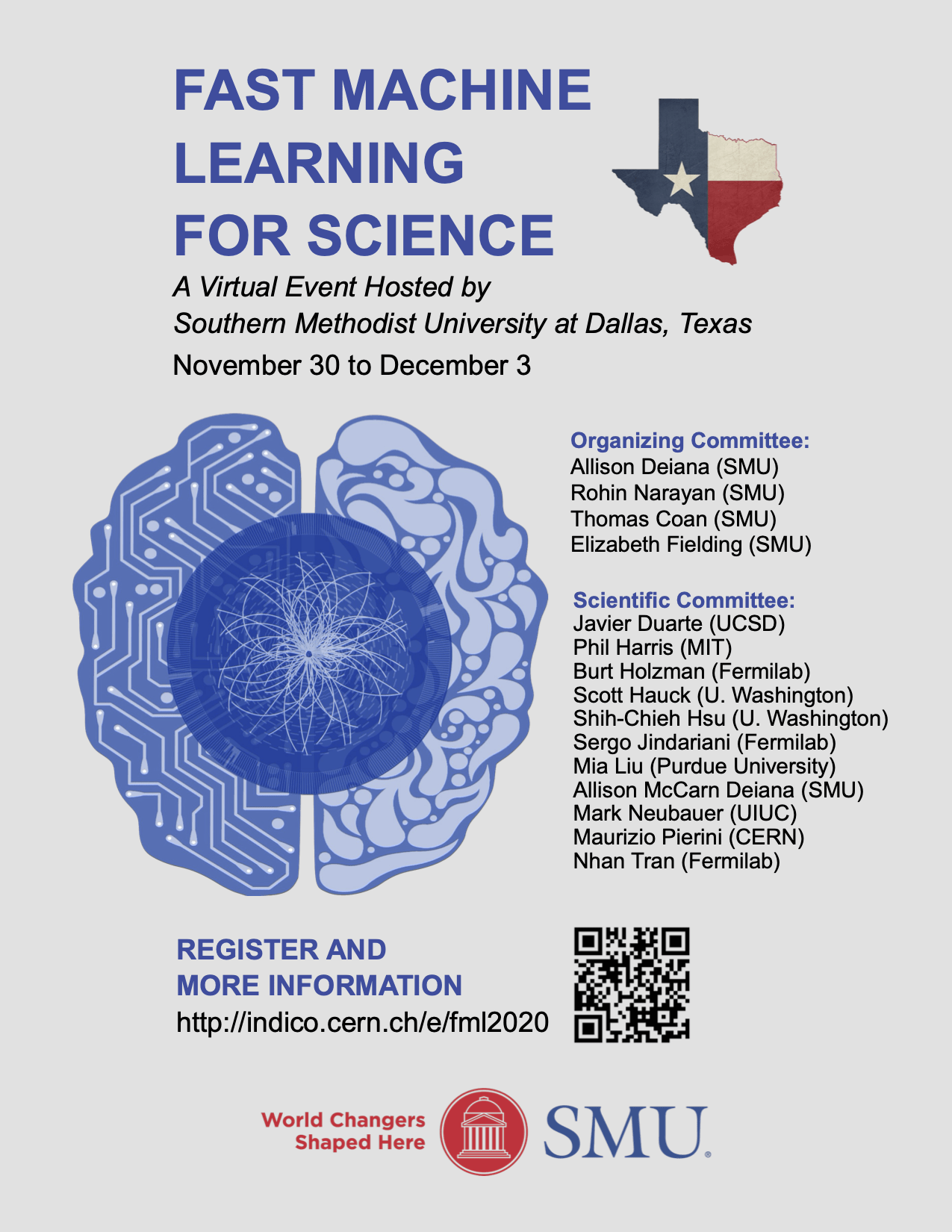 A four-day event, “Fast Machine Learning for Science”, will be hosted virtually by Southern Methodist University from November 30 to December 3. The first three days (Nov 30 – Dec 2) will be workshop-style with invited and contributed talks. The last day will be dedicated to technical demonstrations and coding tutorials.
As advances in experimental methods create growing datasets and higher resolution and more complex measurements, machine learning (ML) is rapidly becoming the major tool to analyze complex datasets over many different disciplines. Following the rapid rise of ML through deep learning algorithms, the investigation of processing technologies and strategies to accelerate deep learning and inference is well underway. We envision this will enable a revolution in experimental design and data processing as a part of the scientific method to greatly accelerate discovery. This workshop is aimed at current and emerging methods and scientific applications for deep learning and inference acceleration, including novel methods of efficient ML algorithm design, ultrafast on-detector inference and real-time systems, acceleration as-a-service, hardware platforms, coprocessor technologies, distributed learning, and hyper-parameter optimization.
Workshop Description
The organizing committee for this event consists of Prof. Allison Deiana, Prof. Tom Coan, Dr. Rohin Narayan, and Elizabeth Fielding from the Dedman College Interdisciplinary Institute. More information, including registration information, is available at the workshop website: https://indico.cern.ch/event/924283/
Physics Speaker Series Continues with a Seminar by Dr. Tim Andeen (UT-Austin) to speak on “Physics from the Top: An Overview of Searches for New Physics with the ATLAS Experiment”
The Physics Department Speaker Series continues on Monday, October 26 with Dr. Tim Andeen (UT-Austin). She will speak on “Physics from the Top: An Overview of Searches for New Physics with the ATLAS Experiment.” This seminar concludes the October theme, “Probing the Unknown.” Dr. Tim Andeen, University of Texas at Austin, will discuss what the most recent period of data-taking at the Large Hadron Collider can tell us about the existence of new laws of nature or new building blocks of the universe. The unprecedented sample of proton-proton collisions, collected from 2015 – 2018, recreate in miniature moments akin to just after the beginning of time. The instrumentation used to probe these collisions is so precise, and the amount of data so vast, that it allows physicists to search even for rare glimpses of fleeting states of matter and energy that might signal the way to a more complete understand of nature. Dr. Andeen will highlight some of these searches and look for the potential unlocked in forthcoming runs of the Large Hadron Collider. Zoom connection information is available to SMU-affiliated participants; the public YouTube stream is available for everyone.

https://www.physics.smu.edu/web/seminars/
Miss a Colloquium or Seminar? Don’t Panic … They’re Recorded!
If you missed an event in the Department Speaker Series, never fear! A positive side-effect of remote-only talks is easy recording. You can find all events so far this semester streaming online here:
Most Recent Talk: Dr. Yulia Furletova (Jefferson National Accelerator Lab)
FACULTY NEWS
If you have something to share please feel free to send it along. Stories of your activities in research, the classroom, and beyond are very welcome!
Reminders for Faculty
- From the Provost: “Exams, tests and quizzes to be delivered exclusively online in fall 2020 – All exams, tests and quizzes will be delivered online this fall so that all students, regardless of mode of instruction, have equitable access to testing. We are discouraging in-class, paper-based testing because of the flexibility that everyone might need if case health issues arise. Consult SMU’s Keep Teaching website for additional information and support for this important interim requirement. You can also view this webinar on Online Exam Basics created by CTE and sent to all faculty by email in late September.”
- From the President: “As President Turner announced … we will start our spring 2021 semester a week later than originally planned, on January 25, and continuing straight forward without a spring break through the conclusion of exams on May 12. Good Friday will remain a University holiday. Jan Term classes will be also be available beginning January 7, 2021.”
STAFF NEWS
Staff In-Office Schedule for Week of October 26
The in-office staff schedule for the week of October 26 is as follows:
- Monday: Michele
- Tuesday: Lacey
- Wednesday: Michele
- Thursday: Lacey
- Friday: Michele (Lacey is out-of-the-office entirely on this day, including virtually)
Of course, both are always available on Microsoft Teams, by Email, or by phone.
Full staff in-office calendar for October:

STUDENT NEWS
If you have something to share please feel free to send it along. Stories of students in research, the classroom, internships or fellowships, awards, etc. are very welcome!
Peilong Wang Defends His PhD Thesis on October 27, 2020 at 6pm
 Graduate student Peilong Wang will defend his PhD thesis on the evening of October 27, 2020. Peilong has been conducting his doctoral research on the ATLAS Experiment at the Large Hadron Collider, focusing on measuring directly the interaction between Higgs particle and the bottom quark, the second-heaviest bulking block of nature. In addition to his contributions to this measurement, he has also worked on hardware research and development projects aimed at future improvements to the ATLAS Experiment. The first hour of the defense is open to the public, after which time the defense will be closed to the public and focus on questions from the defense committee.
Undergraduate Fall Research Symposium – October 28, 3pm-6pm
The Provost announced last week that the “… Office of Engaged Learning and partners will present the undergraduate fall research symposium on Wednesday, October 28 from 3:00 p.m. – 6:00 p.m. At this event, you will have the opportunity to watch undergraduate research presentations from seven distinguished undergraduates via Zoom. Dr. Maryann Cairns from the Department of Anthropology and her undergraduate research assistants will provide the keynote address. Click here to register.“
ALUMNI NEWS
If you are an alum of the doctoral, masters, majors or minor programs in Physics at SMU, or have worked in our program as a post-doctoral researcher, and wish to share news with the community, please send your story to the Physics Department and we’ll work with you to get it included in a future edition.
THE BACK PAGE
Moar Physics! (c/o The Mainz Institute of Theoretical Physics)
Want more in-depth lectures on physics? Love “chalk talks”? Then you’ll love the YouTube page of the Mainz Institute of Theoretical Physics. Enjoy!
https://www.youtube.com/channel/UChcoeBvt1fM3gsZnlXC2AYQ
