


Contents
CHAIR’S WEEKLY MESSAGE
“Saying Goodbye”
One of the most heartbreaking things each semester is to say goodbye to your students, knowing that there is a fair chance that you won’t see them again in another class. It’s particularly tough this semester because there is little hope in the coming months of a serendipitous run-in in a hallway that might allow students and faculty to reconnect. While it is certainly true that all of us always feel a palpable (and well-earned) sense of relief as a result of that final moment of a course, there is always for me a twinge of loss.
Yesterday at 5:13pm I said goodbye to the students in my last meeting of my Cooperative Problem Solving session. I have been leading one of these sessions this semester, and we have no more sessions together after yesterday. The Physics Department recognized many years ago that students benefit from more opportunities to engage in problem solving in a structured and supportive way. Not all faculty are able to incorporate such experiences into their classrooms, though we’re definitely seeing this more with time as people revise their teaching practices or add new ones. At the introductory physics level, where classroom sections can range from 40 students to 130 students, it’s particularly hard to take class time and utilize it for semi-structured, guided problem solving with instructor feedback and peer mentoring.
A few years back, the undergraduate committee reformed our introductory laboratory classes. Each session of lab is 3 hours long and now incorporates 1 hour of problem solving followed by 2 hours of laboratory practice. Achieving this involved adding new components and compressing existing ones, but after hard work between members of the undergraduate committee and our laboratory manager, this was done successfully. For a few years now, we’ve been running the lab sections in this manner. In the face of COVID-19, as much as possible has been put online, compressing data collection to just one of the three hours with a cohort of only 9 students maximum allowed in-person to take data at any time.
Our graduate teaching assistants, typically students in their first or second year of graduate school, traditionally run the “Co-Ops” – that first hour dedicated to team-based problem solving. There are 12 sections of lab in the fall, and so there are usually 12, one-hour Co-Op sessions. This semester, however, to accommodate the rotation of data-taking cohorts, we have expanded the Co-Ops to two hours; 18 students are problem solving in hour 1 and 9 are problem solving in hour 2. This permits students in cohorts of 9 to get into the lab and take their data. Remote students are also accommodated in this process, even while all-virtual.
It was important to me to run one of the 12 Co-Op sessions, to make sure that, as Chair, I don’t lose touch with what is going on in and affecting our earliest learners. This was also important to me as I am supervising the teaching assistants in this process and coordinating their Co-Op activities this term and again in the spring. It’s hard to lead from behind the front lines, so I chose to get into the trenches with the students. Many lessons have been learned from this semester and will be folded into the next term.
While it’s a relief to come to the last session of this Co-Op effort, it was bittersweet. I’ve met many new and extremely bright undergraduates. I’ve watched them struggle to improve their teamwork and apply the basic knowledge gleaned from a first pass in a physics classroom. This Co-Op activity is partly about solving physics problems and mostly about learning to work with unfamiliar people. Though I have been remote this whole time, I’ve watched the students work together in dining halls and Zoom rooms, getting to know each other and solving problems along the way. I will miss this.
The autumn is always about loss and change. Green is lost from the leaves as they turn orange and yellow and red, then finally brown, and are shed by their mother trees. We lose blue skies and warm weather, trading it for steadier breezes, overcast skies, and some rain. I won’t miss the summer heat, but I don’t much look forward to the winter damp, either. For a teacher, shedding one more leaf – a class of students you have worked with and come to understand a little bit better – is nonetheless a kind of small loss.
In this issue of the newsletter, we look ahead to the seminar on Monday about new opportunities to use particle jets to probe the unknown structures inside protons and neutrons, the heart of every atom in the universe. We are also in the middle of day one of the regional Texas Section of the American Physical Society joint meeting with the American Association of Physics Teachers and Society of Physics Students. Many SMU physicists are giving talks there today and tomorrow, and we are excited to see what everyone has to share! The Society of Physics Students also has an upcoming event to help students connect with summer research opportunities!
Autumn is in full swing, the semester is winding down, and we’re all stressed, a little relieved the end is in sight, and maybe a little sad some things are drawing to a close in the process. Let’s celebrate the people we have met and the ideas we have shared this semester, and look ahead to many more opportunities to do so.
Sincerely,

Stephen Jacob Sekula Chair, Department of Physics |
DEPARTMENT VIEWS
ONGOING: Texas Section of the American Physical Society Joint Meeting with the Regional Sections of the Society of Physics Students and Association of Physics Teachers
The joint meeting of the Texas Section of the American Physical Society (TSAPS, including Arkansas and Oklahoma) with the regional American Association of Physics Teachers and Society of Physics Students is ongoing. Many SMU faculty and students are giving presentations at the meeting (see below), and we are excited to share with our colleagues in the region as well as to learn from their research!
Website: https://tsapsf20.uta.edu/
November 13
Parallel Session 5 – Astrophysics
| 4:12 PM | Ryan Staten | Effects of Radial Observational Systematics on Luminous Red Galaxy BAO Measurements |
| 5:24 PM | Noah Pearson | Searching for Gravitational Waves with Strongly Lensed Repeating Fast Radio Bursts |
Parallel Session 6 – High Energy Physics
| 1:28 | 1:40 | Xiaoxian Jing | Parton distributions, nuclear deeply inelastic scattering, and electroweak precision measurements at the LHC |
| 3:34 | 3:46 | Santosh Parajuli | Search for Higgs Boson Pair Production in the Multi-lepton Final State Using Proton-Proton Collision Data at √s = 13 TeV from the ATLAS Detector |
November 14
Morning Opening and Plenary Sessions
| 11:20-11:55 AM Nov. 14 | Keynote Presentation | Fantastical Dark Matter and Where to Find It | Dr. Jodi Cooley Southern Methodist University |
6:30-7:30 PM Closing and Award Ceremony
REMINDER: Fast Machine Learning For Science (Virtual) Workshop at SMU, Nov. 30 – Dec. 3 – Register Today!
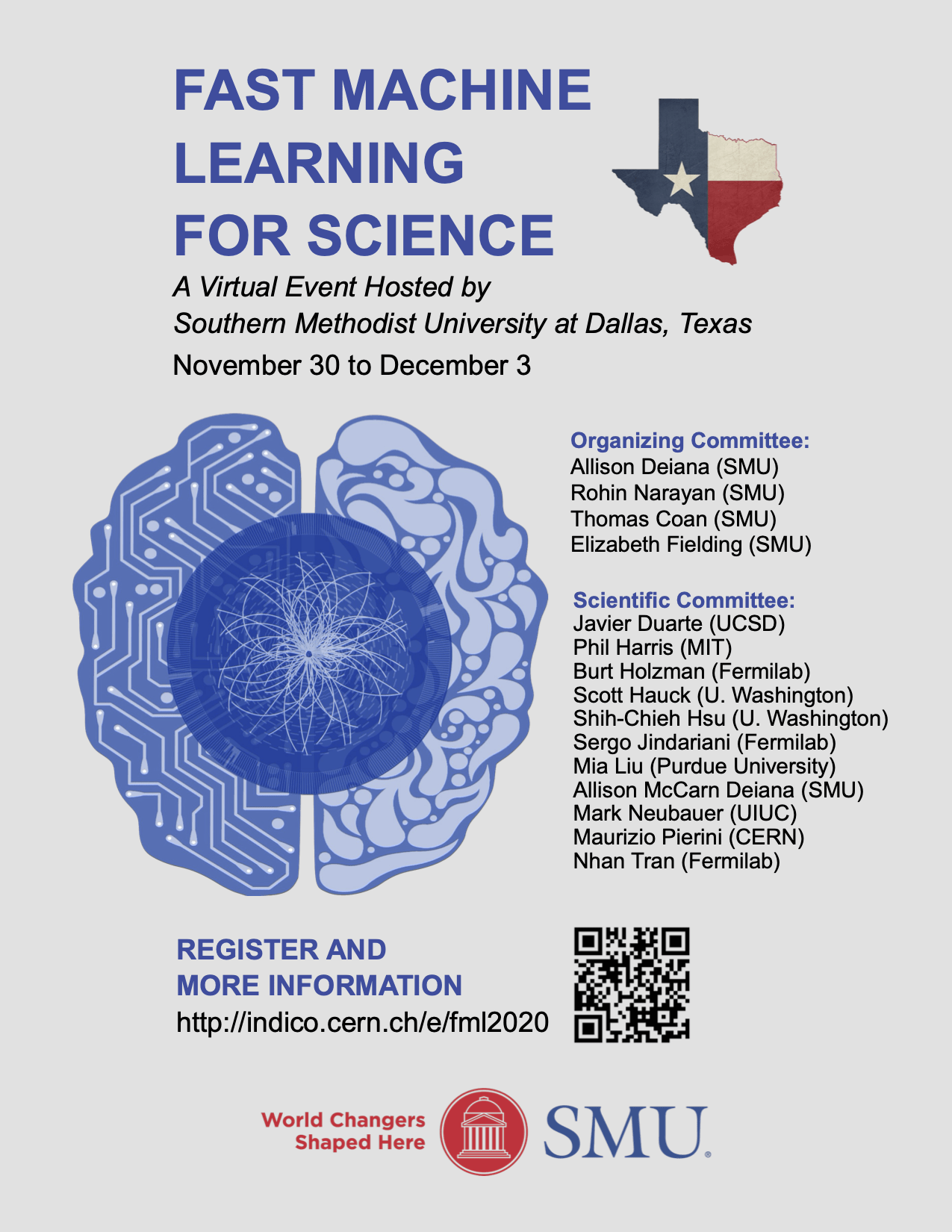 A four-day event, “Fast Machine Learning for Science”, will be hosted virtually by Southern Methodist University from November 30 to December 3. The first three days (Nov 30 – Dec 2) will be workshop-style with invited and contributed talks. The last day will be dedicated to technical demonstrations and coding tutorials.
As advances in experimental methods create growing datasets and higher resolution and more complex measurements, machine learning (ML) is rapidly becoming the major tool to analyze complex datasets over many different disciplines. Following the rapid rise of ML through deep learning algorithms, the investigation of processing technologies and strategies to accelerate deep learning and inference is well underway. We envision this will enable a revolution in experimental design and data processing as a part of the scientific method to greatly accelerate discovery. This workshop is aimed at current and emerging methods and scientific applications for deep learning and inference acceleration, including novel methods of efficient ML algorithm design, ultrafast on-detector inference and real-time systems, acceleration as-a-service, hardware platforms, coprocessor technologies, distributed learning, and hyper-parameter optimization.
Workshop Description
The organizing committee for this event consists of Prof. Allison Deiana, Prof. Tom Coan, Dr. Rohin Narayan, and Elizabeth Fielding from the Dedman College Interdisciplinary Institute. More information, including registration information, is available at the workshop website: https://indico.cern.ch/event/924283/
Physics Speaker Series Continues with a Seminar by Prof. Miguel Arratia (University of California-Riverside): “Jet Tomography of the Proton at the Future Electron-Ion Collider”
The Physics Department Speaker Series continues on Monday, November 16 with Prof. Miguel Arratia (University of California-Riverside). He will speak on “Jet Tomography of the Proton at the Future Electron-Ion Collider.” This continues the November theme, “New Frontiers in Physics.” He will discuss the potential for the future Electron-Ion Collider (EIC) to use electrons to image the quarks and gluons inside protons and neutrons with unprecedented precision. This will allow us to reveal the origin of proton and neutron mass, spin, radius, and other properties. In this talk, Professor Arratia will focus on the prospects of using particle “jets” to perform a “quantum 3D tomography” of the proton at the EIC. The Zoom connection information is available to SMU-affiliated participants; the public YouTube stream is available for everyone.

https://www.physics.smu.edu/web/seminars/
Miss a Colloquium or Seminar? Don’t Panic … They’re Recorded!
If you missed an event in the Department Speaker Series, never fear! A positive side-effect of remote-only talks is easy recording. You can find all events so far this semester streaming online here:
Most Recent Talk: Prof. Stephen Taylor (Vanderbilt University)
FACULTY NEWS
If you have something to share please feel free to send it along. Stories of your activities in research, the classroom, and beyond are very welcome!
Prof. Krista Lynne Smith’s Latest Paper is Accepted for Publication in the Astrophysical Journal: “Confrontation of Observation and Theory: High Frequency QPOs in X-ray Binaries, Tidal Disruption Events, and Active Galactic Nuclei”
Prof. Krista Lynne Smith reports that her latest paper, co-authored with Celia Tandon (Stanford University/KIPAC) and Robert Wagoner (Stanford University) has been accepted by the Astrophysical Journal, a premiere journal of the field. She writes:
We investigated the origin of mysterious oscillations in the luminosity of accreting black holes, both stellar mass and supermassive, called quasi-periodic oscillations or QPOs. Although these oscillations seem to be intimately related to the black hole mass and size scale of the accretion disks, our comparative study indicates that their origin seems to be different in stellar mass black holes than in supermassive ones, challenging some models of the scale-invariance of accretion across many orders of magnitude in black hole mass
Prof. Krista Lynne Smith discussing her latest paper

Dallas Morning News “Science in the City” on Saturday, November 14, 2020

Professors Jodi Cooley and Stephen Sekula will be featured as part of the “Science in the City” series, hosted by the Dallas Morning News. The events are all done virtually this year. This physics event will be delivered as a short film, with open remarks followed by a Q&A after the short film (10 minutes). The event is aimed at Middle and High School students.
Reminders for Faculty
We reprint these, because it never hurts to repeat important things.
- November Faculty Meeting: originally schedule for Nov. 13, this has been moved to Nov. 20 to avoid conflicting with the TSAPS/AAPT/SPS joint meeting at UT-Arlington.
- From the Provost: “Exams, tests and quizzes to be delivered exclusively online in fall 2020 – All exams, tests and quizzes will be delivered online this fall so that all students, regardless of mode of instruction, have equitable access to testing. We are discouraging in-class, paper-based testing because of the flexibility that everyone might need if case health issues arise. Consult SMU’s Keep Teaching website for additional information and support for this important interim requirement. You can also view this webinar on Online Exam Basics created by CTE and sent to all faculty by email in late September.”
- From the President: “As President Turner announced … we will start our spring 2021 semester a week later than originally planned, on January 25, and continuing straight forward without a spring break through the conclusion of exams on May 12. Good Friday will remain a University holiday. Jan Term classes will be also be available beginning January 7, 2021.”
STAFF NEWS
Staff In-Office Schedule for Week of November 16
The in-office staff schedule for the week of November 16 is as follows:
- Monday: Michele
- Tuesday: Lacey
- Wednesday: Michele
- Thursday: Lacey
- Friday: Lacey
Of course, both are always available on Microsoft Teams, by Email, or by phone.
Full staff in-office calendar for November:

STUDENT NEWS
If you have something to share please feel free to send it along. Stories of students in research, the classroom, internships or fellowships, awards, etc. are very welcome!
Next Society of Physics Students Meeting: How to Find Summer Undergraduate Research in STEM
The SMU SPS will host its next event on November 17, 2020 from 6:30-7:30 pm (all virtual). They write:
Summer is a great time for undergraduate students to get involved in research, especially in STEM, but how do you find research opportunities? We will be presenting different summer research opportunities that are available at SMU and beyond, through NSF and other research programs. The presentation is hosted by our current Society of Physics Students executive team and will feature current students who have participated in summer research. We will speak about both the process of applying for research positions and conducting research. This meeting is open to anyone but will be tailored toward undergraduate students. Please join us at the following link: https://smu.zoom.us/j/9066747242
ALUMNI NEWS
If you are an alum of the doctoral, masters, majors or minor programs in Physics at SMU, or have worked in our program as a post-doctoral researcher, and wish to share news with the community, please send your story to the Physics Department and we’ll work with you to get it included in a future edition.
THE BACK PAGE
A solution to the “DeChambeau Drive” Fermi Problem
While we received no student solutions to the “DeChambeau Drive” Fermi Problem from late September, we here provide an example of a possible solution to the problem from Prof. Sekula.
