


Contents
CHAIR’S WEEKLY MESSAGE
“Mental Health Days”
Mental health has probably never been more important. We are a people besieged on all sides. The fury of this pandemic, un-managed by the institutions we would normally trust most to make a coherent response, continues to eat away at every minute of our lives. The urge to be around other people is overwhelming for all of us. In our hearts we know that every contact opportunity, even with multiple precautions taken, is a chance to threaten one’s own life or the life of another person. Yet the urge to return to normal is an overwhelming chemical addiction. We are deeply social creatures – which this terrible virus exploits to its advantage.
With all the challenges of digital teaching heaped on top of hybrid classrooms, with all the deadlines that come fast and furious with seemingly little patience or remorse for those who miss them, and robbed of the kind of social support we need, our mental health is failing.
Let’s just be honest about it for a moment.
I don’t know about you, but my dreams have become more intense during this period. I’ve not dreamed this much since youth, when dreams were still new and vivid and confusing to me. Some of my current dreams follow obvious tropes and archetypes; for instance, most of us are having some version of the “pandemic nightmare,” where we find ourselves in a group of people with no masks and no social distancing. Other dreams are more strange, more subtle, more confusing, and more painful, drawing on difficult themes from my past or present and mixed in with odd story lines and mysterious plots. I know you all understand what I am talking about; I’ll wager you have also experienced gripping and vivid dreams that wake you at 3am and render you unable to fall back to sleep.
Sleep science has enlightened us over many decades on the purpose and necessity of sleep and dreams. Dreams appear to be a way in which the brain, as an organ, itself deals with the sense experiences of the day. Sleep and dreams appear to clean out the biochemical clutter and sort out what belongs in long-term memory storage and what should simply be discarded. Dreams are simulations that let us imagine outcomes and how we would react to them in reality. If we’re all having vivid dreams, it’s no coincidence; our mental health is under constant assault, and our brains are trying to deal with it. We lack the kinds of control over our lives we used to have 12 months ago, when we could go out to a restaurant or a movie theater and generally not fear winding up in the intensive care unit 14 days later. We shall return to that kind of life someday … but based on the rising case counts and hospitalizations in the nation and in North Texas, that day is not upon us.
A number of us at SMU received a survey this week, asking about the mental health and academic impacts of the elimination of Labor Day and Fall Break from the schedule. I was asked to rate how I thought it was affecting students (I selected, in all cases, severe negative effects on students). I was asked to rate how it was affecting me (I was even stronger and clearer about the effects here – all negative).
Why did we get this survey? It’s presumably because the plan is to eliminate all breaks in the spring term, too. The U.S. has precious few holidays to begin with, and having been robbed of those in the autumn the questions are now the following: what health effects did that choice have, and should we do it again in the spring?
No. No. No.
While I understand the reason for it – erasing the holidays was meant to prevent opportunities to spread COVID-19 – there are serious downsides to stealing down-time away from people. A student enrolled in 12 credit hours each week is putting in 12 hours alone in classroom activities, plus at least another 24 hours in out-of-class activities (look up the federal definition of a “credit hour” – I am not kidding). Many students are taking 15 or 18 credit-hours in a semester, putting them well over a typical 40 hour work week (and remember that the out-of-class work is only a minimum recommendation).
That means weekends effectively don’t exist. Academic work consumes the body as well as the mind, and this leads to exhaustion; anyone who’s ever committed themselves to a serious intellectual challenge knows how tired they feel afterward (again, exhaustion being the brain’s way of saying, “Hey! Gimme a break! I need to clean up in here!”). Students and faculty have been on high alert non-stop for 8 weeks now, with another 6 to go before we break for Thanksgiving (a Thanksgiving where we cannot actually be with people as usual anyway).
What was robbed from us this semester was our mental health. Those three days – Labor Day and the two days of Fall Break – were each a chance to put down academic work, walk away, and commit to something else as a brief distraction. Distraction is good for a challenged mind; it allows the brain time to mull on the problem without being forced to do so, and personally I have experienced many breakthroughs while relaxing or jogging. In fact, I now exercise regularly for precisely this reason (apart from the incredibly obvious health effects). Taking the mind out of the arena for a short while allows it to recover, strengthen, and be ready for the fight once more. Leaving the mind in the ring just subjects it to more cuts, more bruises, and more bleeding, with no real chance to heal or strengthen.
Students in my classes mostly report negative mental health effects during a continuous and unbroken 8 weeks of work, work, work with no chance to pause and recover. I only hope that our institution learns from this mistake and, if they plan to rob us all of spring break in the next term, to provide instead 5 mental health days evenly distributed across the semester. This would solve the problem of spreading COVID-19 (avoiding the temptation of a lot of travel, for example) but nonetheless offer our brains a break from the fight.
Humans are not machines, and the first mistake most people make is thinking that we are. Humans are learners, thinkers, creators, and doers. Rest is the chance to refuel and restart the mental engine. I fear what the true cost might be to leave it running again for 14 straight weeks in the spring.
Sincerely,

Stephen Jacob Sekula Chair, Department of Physics |
DEPARTMENT VIEWS
Texas Section of the American Physical Society – Upcoming Joint Meeting with the Regional Sections of the Society of Physics Students and Association of Physics Teachers
 The joint Fall 2020 Meeting of the Texas Sections of the American Physical Society (APS), American Association of Physics Teachers (AAPT), and the Society of Physics Students (SPS) will be held virtually Nov. 12-14, 2020, hosted by UT Arlington. We usually have junior and senior undergraduates attending. If students have done some undergraduate research, we encourage them to present it there. Everyone, especially students, are encouraged to register for the event and submit an abstract if you’d like to present. Registration is free this year and there is no travel required – the event is entirely virtual. If you are asked to pay any fees, please inform the Prof. Simon Dalley, Assistant Chair for Undergraduate Studies, because the department has a budget to cover such expenses.
The meeting itself will occur on November 13 and 14. The deadline for submitting abstracts is October 31st. Details about the meeting can be found at: https://tsapsf20.uta.edu/
The TSAPS offers awards for the best student presentations and research. The most prestigious of these – The TSAPS Robert Steward Hyer Award – is awarded to a student-mentor pair and requires a formal nomination for consideration. The deadline for that is Oct. 25, so you should contact your research mentor IMMEDIATELY if you wish to be nominated for the award. Details of the Robert S. Hyer award and submission rules can be found here: https://engage.aps.org/tsaps/honors/prizes-awards/research-award
REMINDER: Fast Machine Learning For Science (Virtual) Workshop at SMU, Nov. 30 – Dec. 3 – Register Today!
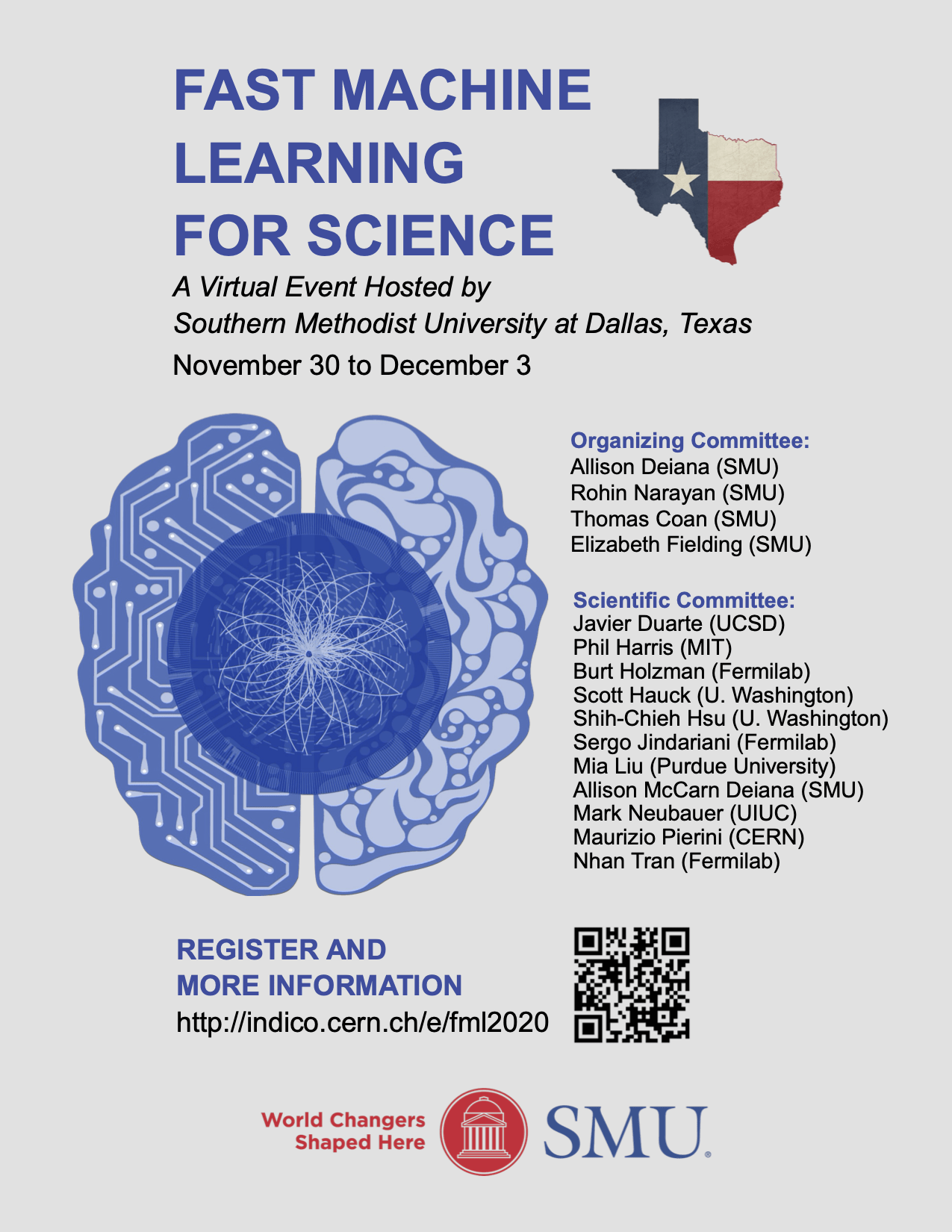 A four-day event, “Fast Machine Learning for Science”, will be hosted virtually by Southern Methodist University from November 30 to December 3. The first three days (Nov 30 – Dec 2) will be workshop-style with invited and contributed talks. The last day will be dedicated to technical demonstrations and coding tutorials.
As advances in experimental methods create growing datasets and higher resolution and more complex measurements, machine learning (ML) is rapidly becoming the major tool to analyze complex datasets over many different disciplines. Following the rapid rise of ML through deep learning algorithms, the investigation of processing technologies and strategies to accelerate deep learning and inference is well underway. We envision this will enable a revolution in experimental design and data processing as a part of the scientific method to greatly accelerate discovery. This workshop is aimed at current and emerging methods and scientific applications for deep learning and inference acceleration, including novel methods of efficient ML algorithm design, ultrafast on-detector inference and real-time systems, acceleration as-a-service, hardware platforms, coprocessor technologies, distributed learning, and hyper-parameter optimization.
Workshop Description
The organizing committee for this event consists of Prof. Allison Deiana, Prof. Tom Coan, Dr. Rohin Narayan, and Elizabeth Fielding from the Dedman College Interdisciplinary Institute. More information, including registration information, is available at the workshop website: https://indico.cern.ch/event/924283/
Physics Speaker Series Continues with a Seminar: Dr. Yulia Furletova (Jefferson National Accelerator Laboratory) to speak on “Probing nuclear gluons with heavy flavors at an Electron-Ion Collider”
The Physics Department Speaker Series continues on Monday, October 19 with Dr. Yulia Furletova (Jefferson National Accelerator Laboratory). She will speak on “Probing nuclear gluons with heavy flavors at an Electron-Ion Collider.” This seminar continues the October theme, “Probing the Unknown.” She will discuss the potential for the planned Electron-Ion Collider to help us unlock the gluon structure inside the proton (and the neutron, as well as heavy nuclei). This is crucial because the gluons provide most of what we think of as “everyday mass,” yet we still understand little about how they provide that structure inside the nucleus of the atom. Gluons are the force-carrying particles that bind quarks together inside the atomic nucleus, providing the significant stability of that structure. Zoom connection information is available to SMU-affiliated participants; the public YouTube stream is available for everyone.

https://www.physics.smu.edu/web/seminars/
Scenes from the Astrophysics Lunch
The Astrophysics Lunch on Mondays is a chance for members of the physics community at SMU to lead discussions on astrophysics and astronomy topics of interest to them. To learn how to propose a topic or how to connect, contact Prof. Joel Meyers.
Learn more about the Astrophysics Lunch: https://astrohep.org/organizations/smu/dokuwiki/doku.php?id=astro_journal_club
Enjoy this scene from the most recent lunch talk on October 9, 2020.

Miss a Colloquium or Seminar? Don’t Panic … They’re Recorded!
If you missed an event in the Department Speaker Series, never fear! A positive side-effect of remote-only talks is easy recording. You can find all events so far this semester streaming online here:
Most Recent Talk: Dr. Laura Blecha (University of Florida)
FACULTY NEWS
We have no faculty news items this week, so we simply remind everyone that if you have something to share please feel free to send it along. Stories of your activities in research, the classroom, and beyond are very welcome!
STAFF NEWS
Staff In-Office Schedule for Week of October 19
The in-office staff schedule for the week of October 19 is as follows:
- Monday: Michele
- Tuesday: Lacey
- Wednesday: Michele
- Thursday: Michele
- Friday: Lacey
Of course, both are always available on Microsoft Teams, by Email, or by phone.
Full staff in-office calendar for October:

STUDENT NEWS
If you have something to share please feel free to send it along. Stories of students in research, the classroom, internships or fellowships, awards, etc. are very welcome!
Next Society of Physics Students Event on October 20, 2020: “Fantastical Dark matter and where to find it”
The Society of Physics Students is pleased to present a lecture by Dr. Jodi Cooley entitled “Fantastical Dark matter and where to find it” on October 20th at 6:30 PM CDT. Students especially are encouraged and welcomed to this event, which will include question and answer time with Dr. Cooley.
The Zoom participation link is: https://smu.zoom.us/j/9066747242.
Physics Chats with the Department Chair: “Monster of the Milky Way”
The Department Chair has begun a series of informal chats with students about the topic of the Speaker Series event each week. The Speaker Series events are on Monday afternoons, and the physics chats are on Tuesday evenings (to try to avoid classes and accommodate more student participation). Last week, the topic was supermassive black holes and the evening featured a screening of the 2006 documentary, “Monster of the Milky Way” (PBS NOVA). The film tells part of the story of the work and discoveries made by new Nobel Laureates Reinhard Genzel and Andrea Ghez. Students had excellent questions afterward, and all seemed captivated by the use and power of “adaptive optics” on telescopes, which proved a real game-changer in the early part of this century. The Chair also provided free food for participants, using Uber Eats to perform food delivery to the students before the event. Like all things in life, this was an experiment (that actually succeeded … this time).
There will be no chat on Tuesday, Oct. 20 because the Society of Physics Students is hosting an event that evening. Students are encouraged to participate in that event instead! (see above)

ALUMNI NEWS
If you are an alum of the doctoral, masters, majors or minor programs in Physics at SMU, or have worked in our program as a post-doctoral researcher, and wish to share news with the community, please send your story to the Physics Department and we’ll work with you to get it included in a future edition.
THE BACK PAGE
Students and Mental Health during the COVID-19 Pandemic
- SMU Students can apply for financial assistance as a result of COVID-19: https://cm.maxient.com/reportingform.php?SouthernMethodistUniv&layout_id=1
We provide a look at the mental health impact especially on students during this pandemic, as provided by Inside Higher Ed. This article will help us understand better what students are going through during this strange time, highlight the complexities of this particular mental health challenge, and perhaps allow us to understand each other better as we go forward through the autumn.
While COVID-19 may make it harder for students to access the mental health resources they need, one potential bright spot is that the pandemic has reduced the stigma of needing and getting mental health support. Whitlock, director of the Cornell research program, said in some ways there is now a “lower bar for seeking help” because of how much mental health is now talked about and new services are offered. Davis, of Mental Health America, said the pandemic has been a “reckoning” for mental health discussions.
“The hopeful piece for me is it seems like we’re at an inflection point,” Davis said. “All of a sudden, it’s OK to talk about mental health.”
From “Mental Health Needs Rise With Pandemic”, Inside Higher ED, September 11, 2020.
Anderson, G. “Mental Health Needs Rise With Pandemic”. Inside Higher Ed. 9/11/2020. https://www.insidehighered.com/news/2020/09/11/students-great-need-mental-health-support-during-pandemic
