“One of our major concerns is background particles that can mimic the dark matter signature in our detectors.” — Jodi Cooley
SMU physicist Jodi Cooley is a member of the international scientific team that will use a powerful new tool to understand one of the biggest mysteries of modern physics.
The U.S. Department of Energy has approved funding and start of construction for SuperCDMS SNOLAB, a $34 million experiment designed to detect dark matter.
SuperCDMS will begin operations in the early 2020s to hunt for hypothetical dark matter particles called weakly interacting massive particles, or WIMPs.
“Understanding the nature of dark matter is one of the most important scientific puzzles in particle astrophysics today,” said Cooley, an associate professor of experimental particle physics. “The experiment will have unprecedented sensitivity to dark matter particles that are hypothesized to have very low mass and interact very rarely. So they are extremely challenging to detect. This challenge has required us to develop cutting edge detectors.”
Cooley is one of 111 scientists from 26 institutions in the SuperCDMS collaboration. SMU graduate students on the experiment include Matt Stein (Ph.D. ’18) and Dan Jardin; and also previously Hang Qiu (Ph.D. ’17).
Physicists are searching for dark matter because although it makes up the bulk of the universe it remains a mystery. They theorize that dark matter could be composed of dark matter particles, with WIMPs a top contender for the title.
If dark matter WIMP particles exist, they would barely interact with their environment and fly right through regular matter. However, every so often, they could collide with an atom of our visible world, and dark matter researchers are looking for these rare interactions.
The SuperCDMS experiment will be the world’s most sensitive for detecting the relatively light WIMPs.
Cooley and her students in the SMU Department of Physics have been working with Washington-based Pacific Northwest National Laboratory on the challenge of background control and material selection for the experiment’s WIMP detectors.
Understanding background signals in the experiment is a major challenge for the detection of the faint WIMP signals.
“One of our major concerns is background particles that can mimic the dark matter signature in our detectors,” Cooley said. “As such, the experiment is constructed from radiopure materials that are carefully characterized through a screening and assay before they are selected.”
The SMU research team also has performed simulations of background particles in the detectors.
“Doing this helps inform the design of the experiment shield,” Cooley said. “We want to select the right materials to use in construction of the experiment. For example, materials that are too high in radioactivity will produce background particles that might produce fake dark matter signals in our detectors. We are extremely careful to use materials that block background particles. We also take great care that the material we use to hold the detectors in place — copper — is very radiopure.”
The experiment will be assembled and operated within the existing Canadian laboratory SNOLAB – 6,800 feet underground inside a nickel mine near the city of Sudbury. That’s the deepest underground laboratory in North America.
The experiment’s detectors will be protected from high-energy particles, called cosmic radiation, which can create the unwanted background signals that Cooley’s team wants to prevent.
SuperCDMS SNOLAB will be 50 times more sensitive than predecessor
Scientists know that visible matter in the universe accounts for only 15 percent of all matter. The rest is the mysterious substance called dark matter.
Due to its gravitational pull on regular matter, dark matter is a key driver for the evolution of the universe, affecting the formation of galaxies like our Milky Way. It therefore is fundamental to our very own existence.
The SuperCDMS SNOLAB experiment will be at least 50 times more sensitive than its predecessor, exploring WIMP properties that can’t be probed by other experiments.
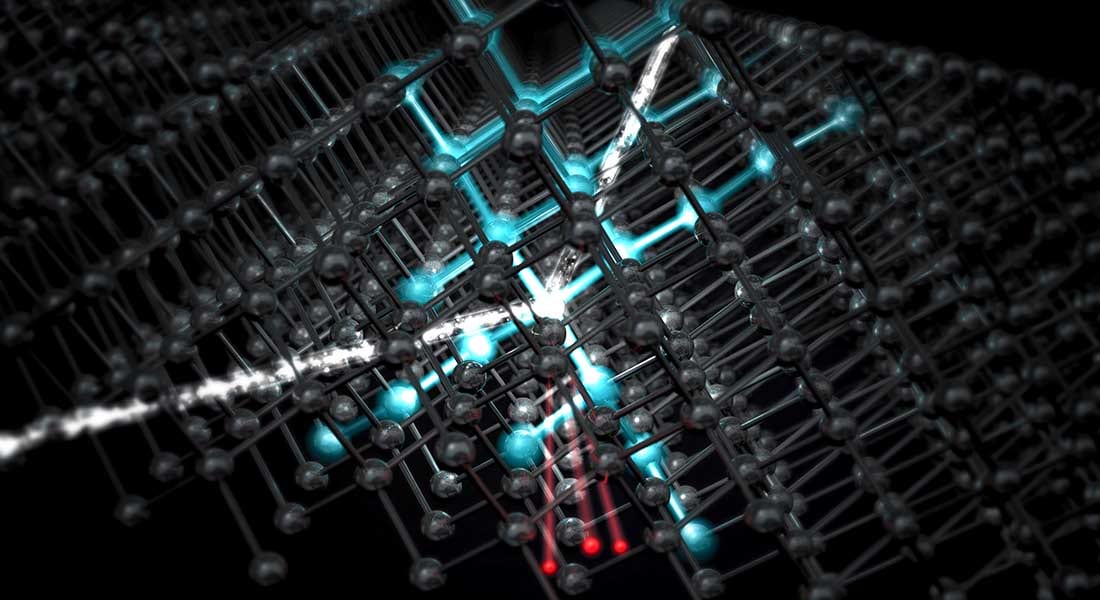
The search will be done using silicon and germanium crystals, in which the collisions would trigger tiny vibrations. However, to measure the atomic jiggles, the crystals need to be cooled to less than minus 459.6 degrees Fahrenheit — a fraction of a degree above absolute zero temperature.
The ultra-cold conditions give the experiment its name: Cryogenic Dark Matter Search, or CDMS. The prefix “Super” indicates an increased sensitivity compared to previous versions of the experiment.
Experiment will measure “fingerprints” left by dark matter
The collisions would also produce pairs of electrons and electron deficiencies that move through the crystals, triggering additional atomic vibrations that amplify the signal from the dark matter collision. The experiment will be able to measure these “fingerprints” left by dark matter with sophisticated superconducting electronics.
Besides Pacific Northwest National Laboratory, two other Department of Energy national labs are involved in the project.
SLAC National Accelerator Laboratory in California is managing the construction project. SLAC will provide the experiment’s centerpiece of initially four detector towers, each containing six crystals in the shape of oversized hockey pucks. SLAC built and tested a detector prototype. The first tower could be sent to SNOLAB by the end of 2018.
Fermi National Accelerator Laboratory is working on the experiment’s intricate shielding and cryogenics infrastructure.
“Our experiment will be the world’s most sensitive for relatively light WIMPs,” said Richard Partridge, head of the SuperCDMS group at the Kavli Institute for Particle Astrophysics and Cosmology, a joint institute of SLAC and Stanford University. “This unparalleled sensitivity will create exciting opportunities to explore new territory in dark matter research.”
Close-knit network of strong partners is crucial to success
Besides SMU, a number of U.S. and Canadian universities also play key roles in the experiment, working on tasks ranging from detector fabrication and testing to data analysis and simulation. The largest international contribution comes from Canada and includes the research infrastructure at SNOLAB.
“We’re fortunate to have a close-knit network of strong collaboration partners, which is crucial for our success,” said Project Director Blas Cabrera from KIPAC. “The same is true for the outstanding support we’re receiving from the funding agencies in the U.S. and Canada.”
Funding is from the DOE Office of Science, $19 million, the National Science Foundation, $12 million, and the Canada Foundation for Innovation, $3 million.
SuperCDMS to search for dark matter in entirely new region
“Together we’re now ready to build an experiment that will search for dark matter particles that interact with normal matter in an entirely new region,” said SuperCDMS spokesperson Dan Bauer, Fermilab.
SuperCDMS SNOLAB will be the latest in a series of increasingly sensitive dark matter experiments. The most recent version, located at the Soudan Mine in Minnesota, completed operations in 2015.
”The project has incorporated lessons learned from previous CDMS experiments to significantly improve the experimental infrastructure and detector designs for the experiment,” said SLAC’s Ken Fouts, project manager for SuperCDMS SNOLAB. “The combination of design improvements, the deep location and the infrastructure support provided by SNOLAB will allow the experiment to reach its full potential in the search for low-mass dark matter.” — SLAC National Laboratory; and Margaret Allen, SMU